 voxolith
bench
The renderer benchmark: one fixed, deterministic scene at 20, 50 or 100 voxels per metre that takes every expensive renderer path, seen from four fixed views.
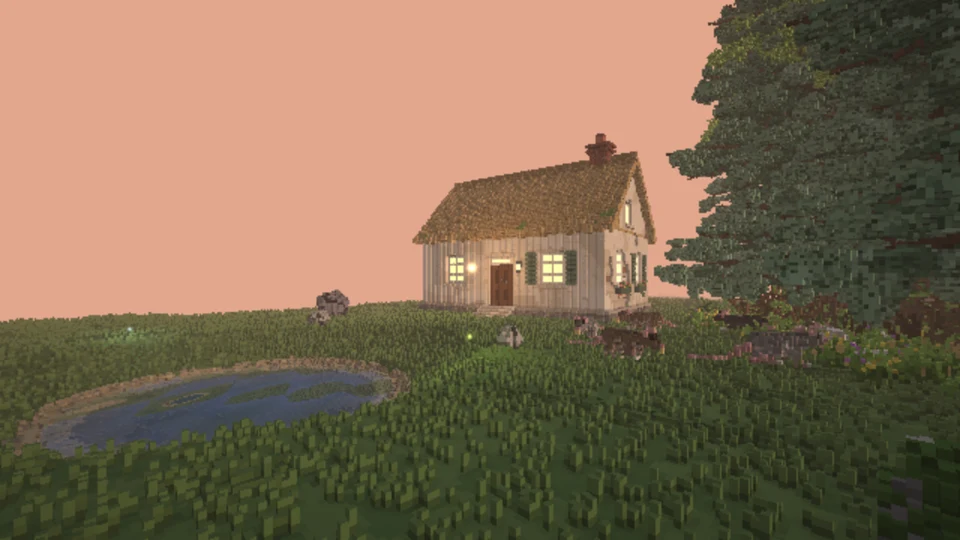
Not a showcase: a test scene for measuring the renderer. It is small enough to build in a few seconds at 20 voxels per metre and still tolerable at 100, and it takes every expensive path the renderer has, so one run at each scale settles whether a renderer change is faster or slower. Every length is in metres, so the scene is the same at every scale.
What the scene holds
A 40 m square of low ground at dusk:
- A dense instanced wood. Oak, birch and spruce (four tree models), with 220 bushes and 360 ferns and grasses underneath: long, overlapping instance lists.
- Stamped and instanced things side by side. Boulders are stamped into the world; the cottage is an instance, with its windows lit (emissive glass).
- Water. A pond, animated from the frame's time.
- Point lights. Two shadowed ones (a lantern at the cottage door, a lamp in the wood) and four unshadowed ones.
- Fog with a view distance.
fog.distancestops every primary ray within 32 m. - Things that move. Four small stones circle the pond as a dynamic instance set, and six rats
walk a circle beside it, posed on the GPU
(
makeCrowdrigged). They are sized with gen-creature'satScaleat every scale, so below 100 voxels per metre they are larger than life.
Nothing depends on the clock. The seed is fixed, nothing calls Math.random, and whatever moves
(stones, rats, water) advances a fixed 1/60 s per drawn frame, so two runs draw the same frames.
The render scale is fixed (there is no makePerf), every frame is drawn, and there is no phone
profile: the page runs as asked everywhere.
The four views
?view= | the camera |
|---|---|
| 0 | inside the wood, towards its heart: canopies and undergrowth |
| 1 | across the open ground: the boulders, the pond and the cottage |
| 2 | close on the pond, the stones, the rats and the cottage |
| 3 | up past the wood's edge into the sky |
URL options
| option | default | effect |
|---|---|---|
?vpm= | 20 | voxels per metre: 20, 50 or 100; anything else snaps to the nearest |
?view= | 0 | one of the four views; all starts at 0, and bench.setView() with no argument steps to the next |
?renderScale= | 0.5 | the fixed render scale |
?quality= | high (low on a CPU adapter) | low, medium or high; maxSteps is 1024 in every preset, since fog.distance bounds the rays |
?anim=1 | move things by the wall clock instead of the frame counter | |
?e2e | expose window.bench, below |
Plus the common ones. The HUD shows the scale, the view, the preset, the GPU time and the fps.
The test hook
With ?e2e, window.bench gives a tool what it needs:
| member | does |
|---|---|
ready() | true once everything is generated, placed and streamed, and a frame is drawn |
setView(i?) | one of the four views; with no argument, the next one |
frames(n) | a promise that resolves once n more frames are drawn and the GPU has finished them |
stats() | vpm, view, fps, gpuMs (GPU ms per pass), width, height, models, instances and loadMs (generate, upload, place, ground, pipelines, total; place is a synchronous setInstances on purpose, so it stays the renderer's own cost rather than a worker's) |
setDebug(v) | renderer.setDebug(v) |
setQuality(patch) | renderer.setQuality(patch); null restores the page's own (its preset with maxSteps 1024) |
freeze(on) | while on, nothing advances: the crowd and the dynamic set stay put and the water holds still, and frames are still drawn; freeze(false) resumes from the same state |
setViewDistance(v) | caps the frame's fog.distance (voxels) at the smaller of the page's and v, so a no-skip walk's step cap is not reached first; null restores the page's |
The maintainers' workspace has a render-bench tool that drives this page on a real GPU at 20,
then 50, then 100 voxels per metre, each scale only if the one below showed no regression against
a saved baseline. Per view it reports the median GPU time over alternated rounds, and a parity
check: the pixels that differ between the normal walk and the no-skip walk (setDebug(1)), with
shadows off and motion frozen.
See also Quality and performance, Instances and the nightwood example.
rigged
The same rats baked on the CPU and posed on the GPU from one rest model, side by side, one pair per clip, to compare joints and cost.
Troubleshooting
Fixes for WebGPU missing or slow, software adapters, lost devices, HTTPS on phones, blank canvases, share codes, big worlds on phones, loading text that does not update, a model or scene cache that stays cold and an app that does not load offline.